Based on my observations and preliminary research (supported by data at the end of this post), the algorithm and AI-driven era is presenting a profound paradox: while the total volume of articles, videos, and images on the internet is exploding, the effective information density is visibly declining. This is a highly thought-provoking, yet exceptionally “dangerous” signal.
Before the widespread adoption of LLMs (Large Language Models), my typical workflow for tackling complex bugs or edge cases was to consult official documentation or use search engines to hunt for solutions across various Stack Overflow threads or personal technical blogs.
However, ever since I embraced Vibe Coding, this workflow has been completely reshaped. I’ve grown accustomed to asking AI directly for answers. As a result, official manuals and technical blogs are gradually being marginalized from my browser bookmarks.
This shift has made me suddenly realize a disturbing trend: in the future, there may be fewer and fewer people willing to write technical blogs.
Looking back at high-quality technical content, the original intention of most creators was simply “to keep a record for themselves”—documenting the practical steps of developing or configuring a service, and highlighting the pitfalls and core takeaways. This “byproduct of struggle” inadvertently became a guiding beacon for those who came after. However, as AI tools are increasingly used to solve specific engineering problems, this kind of experience sharing and work logging based on real-world combat will drastically shrink, thereby accelerating the collapse of the internet’s “effective information density.”
A deeper crisis lies in the fact that the formidable capabilities demonstrated by AI today are fundamentally built upon the “computing power dividends” generated by the explosion of computer applications over the past few decades, as well as the massive trove of high-quality content accumulated during the internet era. If publicly available “useful information” on the internet gradually dries up, the evolutionary speed at which LLMs can solve new problems will inevitably hit a wall.
Perhaps a few years down the line, new knowledge on the internet will have become utterly lackluster, while the public remains deeply reliant on LLMs as their sole gateway to information. By then, we might discover that human civilization and technological exploration have unwittingly walked into a catch-22, a dead end with no optimal way out.
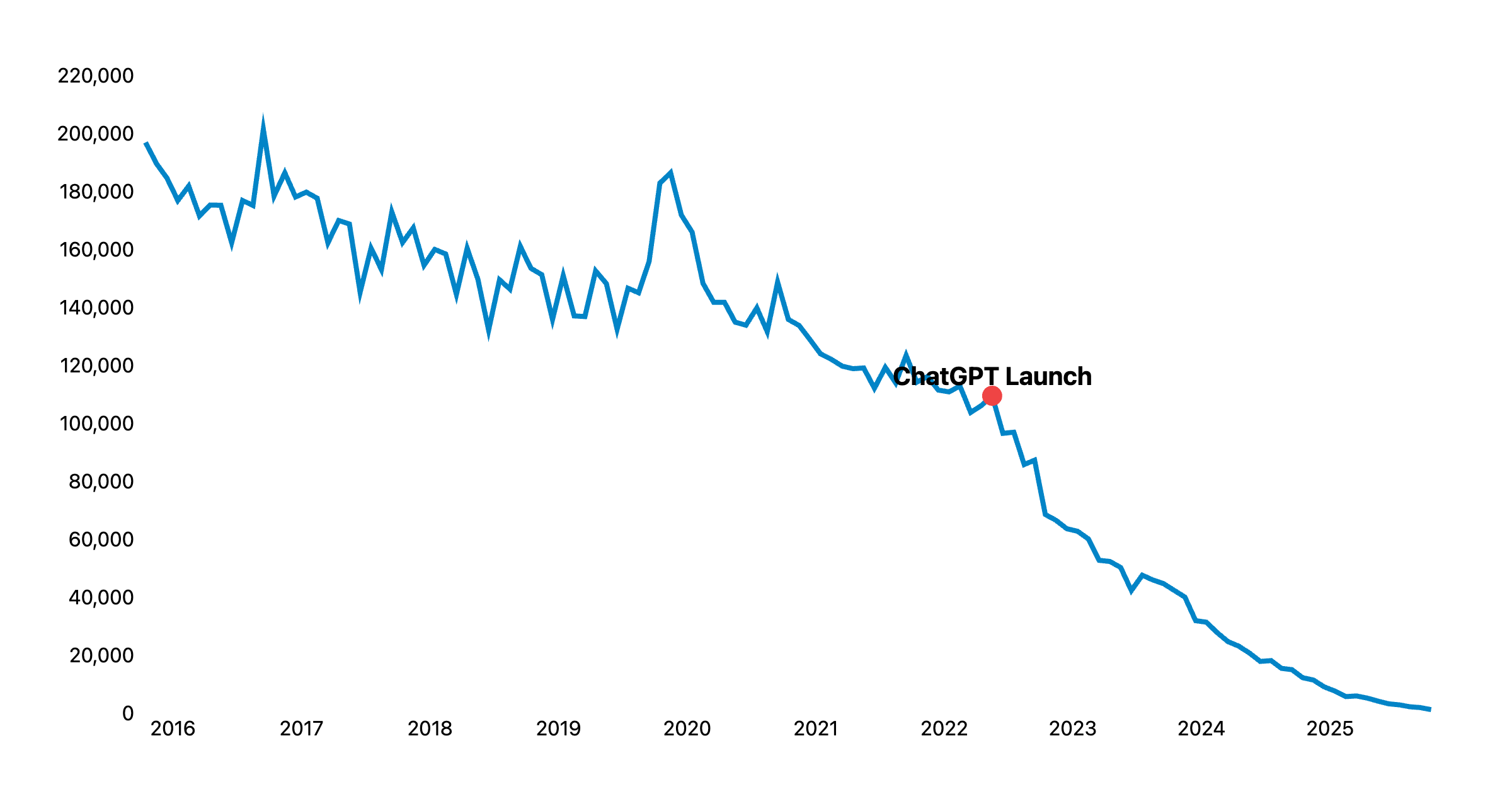
Data Reference: Stack Overflow Question Trends
As shown in the chart below, following the popularization of AI tools (especially ChatGPT), the activity levels in traditional developer Q&A communities have experienced a significant drop. This is perhaps a perfect reflection of the “decline in internet effective information density”:
Source: Stack Overflow Data Explorer (SEDE)
Query Date: 2026-04-19
Note: The data reflects the total number of new questions created each month.